
1st July 2024 marked the beginning of this Arts and Humanities Research Council funded project “Against the Grain: The Kichwa Film of Alberto Muenala and RUPAI”, part of United Kingdom Research Innovation (UKRI). I would like to start by giving thanks to the assessors of this proposal for seeing the value in this project.
Over the next 24 months, the aims of this research project are to provide the first detailed and critical account of the emergence of Runa-Kichwa cinema in the Otavalo area by focusing on the pioneering work of one of the earliest and longest standing Indigenous-run film organisations in Abya Yala (or Latin America), RUPAI, which has been led by the Kichwa film director and producer Alberto Muenala alongside other members of his family and community. It is the relationship and trust that I have built up with the Muenala-RUPAI family over the past five years that has made the proposal of this project possible, and for that I would also like to give thanks to them for their trust in carrying out this research.
The objectives of this project are, first and foremost, to document the history and influence of RUPAI on an emerging Indigenous-led film movement in Abya Yala (and more specifically Kichwa film in the Imbabura region). In focusing closely on this one case and considering the perspectives of many different people who have been involved in it, the project hopes to raise critical questions which are central to the study of the film production of the First Nations of Abya Yala. What does it mean, for example, to focus on the work of an filmmaker-auteur, when considering a film production that establishes itself as community based? How do we think of the political role that film plays in community activism, and what are its limitations? In what ways are notions of community production navigated by conditions of production that do not lend themselves to community processes, as well as by individual or group interests? What are the conditions that made possible the emergence of Kichwa-Runa film, what does this mean for those involved, and does it represent some voices or visions over others? How are we to understand the influences of ethnic, cultural, linguistic, class, gender and sexual diversity in such film production, and what is its relationship to the renovation of cultural practices and understandings of what it means to be Kichwa today? These questions, among others, will inform the direction that the research will take, thus hoping to provide more than a historical overview. At the same time, the research project seeks to actively draw from the voices and views of filmmakers and others involved to shape its agenda, and to ask how the research process can ally with the political and cultural interests of those cultural activists, rather than reproduce traditional hierarchical relationships between academic knowledge production and its “objects.”
In that sense, I am very pleased to be able to launch the project website with the support of the digital artwork of the Otavalo-based graphic designer David Gramal, owner of Grama Estudio Creativo. We discussed the design concept together, knowing I wanted to reflect something of the vibrancy and complexity of the Kichwa culture whilst avoiding a kind of cultural appropriation. I had suggested to David that we should include a camera and the eyes of the Aya Huma, a central spiritual character of the significant Inti Raymi celebrations and which RUPAI use for their own branding. By focusing on the eyes, I explained, I wanted to reflect the idea of a cinematic vision that came from and projected the vision of the peoples whose history and stories informed the film production I wanted to research. With this vague sense of what I had hoped for, David put together something I could never have expected: a digital tapestry that interwove the Kichwa cosmovision whilst reflecting the history of RUPAI.
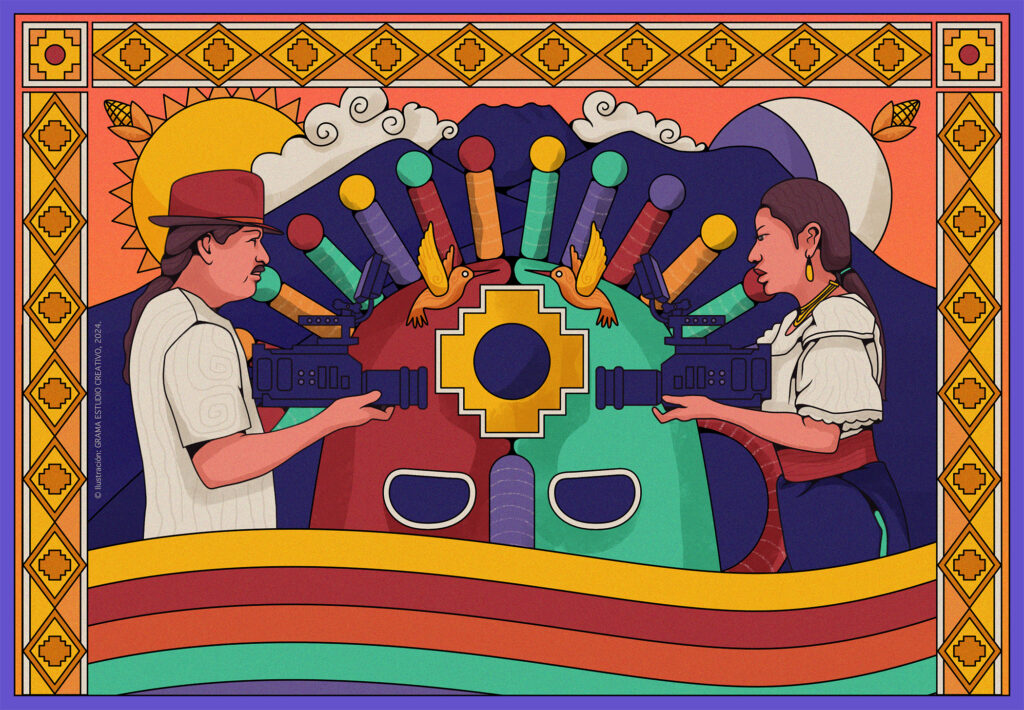
With the Imbabura volcano in the background, a sacred site and deity which gives its name to the Imbabura region, David portrayed the duality of the sun (Inti) and moon (Killa), which reflects in turn the duality of man and woman, mirrored by the two filmmakers facing one another in traditional Kichwa dress (which, for anyone who knows them, bear a striking resemblance to Alberto and Frida Muenala, father and daughter and filmmakers central to RUPAIs productions). The eyes of the Aya Huma gaze over the rainbow-like waves reflecting the colours of the Andean-Indigenous flag the wiphala, but also evoking the title of the research project in Spanish, “counter-current” (which I chose to translate into English as “Against the Grain”). In the forehead or the third eye of the Aya Huma we have a chakana, an important and ancient Andean symbol, which also provides the design for the frame of this digital tapestry. Finally, the corn and the hummingbirds add further Andean symbolism to the composition. As David told me during the design process, the currents of the wiphala-coloured waves “represent how our culture continues to flow without end like the waters of a river.” I am deeply touched by his efforts with this digital illustration and like to imagine that, perhaps, his investment in such a powerful piece of artwork reflects his sense that there is something worthwhile in what this project hopes to recover. In my mind, the cameras of the two Kichwa filmmakers blend in with the tapestry, becoming just one more tool in the arts of the Kichwa cultural heritage, much like David Gramal’s own design presents a modern twist on cultural practices whose cultural heritage is thousands of years old.
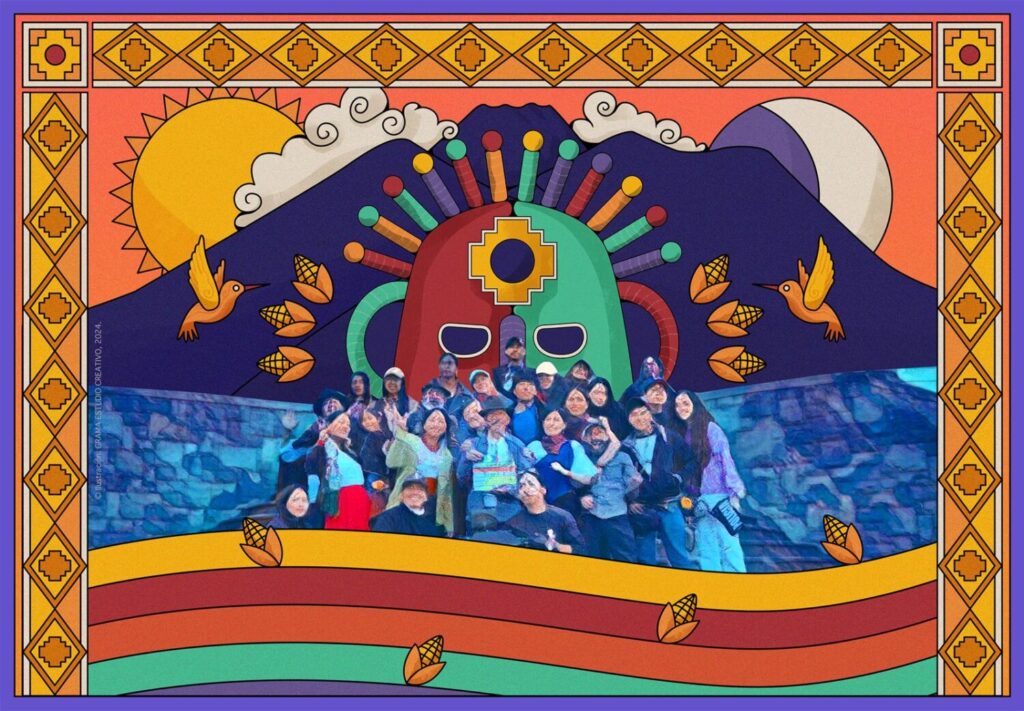
When I sent the design to Alberto and Frida Muenala for feedback, they both felt that putting their two persons in the foreground of the design did not do justice to the collective nature of the work that has been carried out by RUPAI. They suggested to send David Gramal a photograph showing RUPAI as a collective, which could then be incorporated into the design instead of using visual representations of themselves. So going back and forth between them and David, we eventually came to a compromise on design, the digital tapestry of which can be seen below (and a version of which has been used for the banner for the project website):
The use of David Gramal and his studio’s artwork and vision forms part of an approach that has been embedded into the design of this research project. It constitutes what I hope can be considered a respectful approach to the critical study of film production from Abya Yala, both foregrounding the voices and visions of First Nations peoples, whilst at the same time seeking not to avoid the question of my own responsibility as a researcher from and based in the Global North, and my ethical obligation to provide a critical account of this film history. Part of this includes basing my research on interviews with various actors who have been involved in RUPAI’s historical process, and I hope that many of these interviews, with the permission of the participants, will be published in this website in the coming months. It is also reflected in the title of the project itself. “A contracorriente”, translated into English as “Against the Grain” but literally meaning “against the current”, was an expression used by the early members of RUPAI to describe their political and cultural activism. The phrase came out of a series of initial interviews with Alberto Muenala that formed the background to this project, and that I will publish on the website in the coming weeks.
Wanting to foreground the voices of those who had promoted this film activism, then, I began the project with a field trip to Ecuador from July to August 2024 to meet and converse with those filmmakers, actors, and other important people from the creative and technical teams. My stay went beyond the expectations I had of it. I was able to make many important contacts there, converse almost everyday with the Muenala family, carry out sixteen interviews (with hopefully more to take place online), and consult archives in the national film archives, the Casa de la Memoria in the national Indigenous organisation the CONAIE, and in RUPAI’s own private collection. Along the way, I had the privilege of being able to participate in various cultural activities that reminded me of how vibrant and active the Kichwa political and cultural scene is in Imbabura. The artwork for this website came out of these contacts and conversations. Without doubt one of the highlights of the stay, however, was being able to put on a community showcase of RUPAI’s films in the central square in the community of Peguche just outside of Otavalo. I will provide more detail of these events and activities in a future post. For now, I would just like to reiterate my thanks again to all those that welcomed me and were willing to converse with me and open up to me, this stranger from a foreign land, and of course to the Taita Imbabura and Mama Cotacachi for allowing me safe passage.